Exiting VMware: a Web3 game studio's first production wave on AWS
An Indonesian game studio with 129 server components on self-managed VMware landed its first production wave on AWS in July 2026 — Control Tower landing zone, MySQL replatformed to RDS Multi-AZ, recovery objectives tested before cutover, and two more waves scheduled.
Summary. An Indonesia-based game studio operating Web3-enabled titles across Southeast Asia ran 129 server components on a self-managed VMware estate in a single facility, with twelve MySQL servers as the platform's single point of failure. Skybit Technologies designed a three-wave migration to AWS under the AWS Migration Acceleration Program (MAP Lite). The first production wave – the pilot – cut over in July 2026 with a seven-day hypercare period and a go-live confirmed by the customer's CTO; the remaining waves are scheduled through 2026.
At a glance
- Industry: Online gaming – Web3-enabled multiplayer titles
- Region: Indonesia; players across Southeast Asia
- Source: VMware on-premises – 129 migration components (116 application VMs, 12 MySQL database servers, 1 load-balancer replacement)
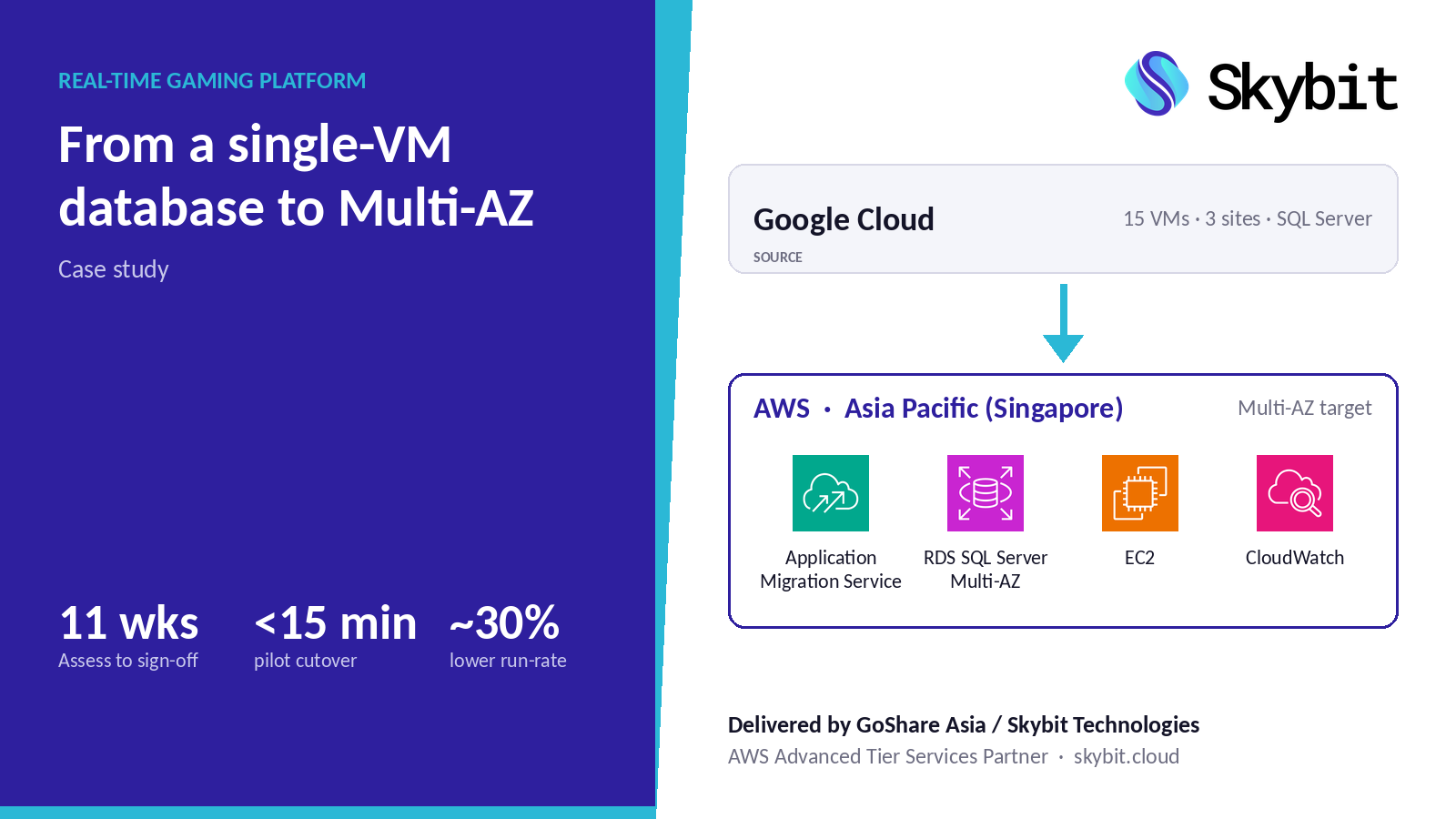
- Target: AWS Asia Pacific (Singapore), Multi-AZ
- Programme: AWS Migration Acceleration Program (MAP Lite): Assess → Mobilize → Migrate in three waves
- Timeline: Assess early 2026; Mobilize May – June 2026; Wave 1 live July 2026; Waves 2–3 scheduled 2026
- Key services: AWS Control Tower, AWS Application Migration Service, AWS Database Migration Service, Amazon EC2 with Auto Scaling, Amazon RDS for MySQL (Multi-AZ), Amazon CloudWatch, AWS WAF, Amazon GuardDuty, AWS Security Hub
The challenge
The studio's estate had grown into seven application groups – game engines, multiplayer socket servers, API, back office, game services and databases – on 128 VMware servers with 890 vCPU, over 3 TB of RAM and 60 TB of provisioned storage, all production. Three things drove the decision to move:
- Fixed cost and a hardware refresh cycle. VMware licensing and co-location were a significant annual fixed cost, with a refresh looming.
- Traffic that fixed capacity cannot absorb. NFT drops, token launches and on-chain events produce spikes many times the baseline; on-premises the only answer was over-provisioning against a forecast.
- Twelve MySQL servers with no cross-zone standby. The platform's transaction and player-state data had no automated failover, and availability sat below 99.9%.
The approach
Assess. Portfolio discovery with AWS Transform across the 128 servers, a Migration Readiness Assessment, 7Rs classification (116 rehost, 12 replatform, 1 replace) and a TCO comparison against the on-premises cost by category – compute, licences, data centre, network, security tooling and IT labour – presented to the customer before implementation.
Mobilize. An AWS Control Tower landing zone built with Account Factory Customization and Terraform, a security baseline aligned to the AWS Security Reference Architecture and the CIS AWS Foundations Benchmark, per-tier security groups, and a cutover and SLO plan that fixed the recovery objectives (RTO under 90 minutes, RPO under 5 minutes) and the rollback triggers before any production traffic moved.
Migrate. Three waves. Wave 1 – the pilot – proved all migration methods at once: AWS Application Migration Service for the rehosted servers, AWS Database Migration Service for the MySQL servers into Amazon RDS for MySQL Multi-AZ, with an RDS failover test executed before the switch-over. Wave 2 moves the 100 game-engine and socket-server VMs on the validated runbooks; Wave 3 covers validation, cost optimisation, Auto Scaling tuning and operational handover.
The pilot wave
Wave 1 cut over in the off-peak window in late July 2026 after a cutover test two weeks ahead, functional and load validation, an RDS Multi-AZ failover test and customer UAT. Seven days of hypercare followed with daily CloudWatch review; the Wave 1 go-live was confirmed in writing by the customer's CTO and Skybit's project manager, and the lessons from the wave were written into the Wave 2 runbook.
Results and expected outcomes
- Achieved – July 2026, hypercare complete: first production wave live on AWS with the database tier on RDS Multi-AZ
- Achieved – Mobilize: landing zone with Control Tower guardrails, CIS-aligned security baseline, infrastructure as code
- Achieved – tested at Wave 1: recovery objectives defined and tested (RTO < 90 min, RPO < 5 min)
- In progress – Waves 2–3, 2026: full estate migrated; VMware licensing and co-location exited
- Projected – from the business case, measured after Wave 3: net TCO reduction of about 14% a year, driven by licence elimination, data-centre exit and lower operations effort
- Target – measured against CloudWatch after full migration: 99.9%+ availability through Multi-AZ and Auto Scaling
What this engagement shows
A first-time move to AWS does not have to wait for everything to be ready. Landing the pilot wave – including the riskiest part, the databases – on validated runbooks gives the customer a production reference point, a tested recovery position and real cost data before the bulk of the estate moves.
Skybit Technologies (GoShare Asia) is an AWS Advanced Tier Services Partner based in Malaysia, delivering migration and managed services for gaming and digital-native businesses across Southeast Asia. Customer identity withheld at the customer's request. This case study will be updated when the remaining waves complete.
..png)